About Me

My photo
No Fixed Abode, Home Counties, United Kingdom
I’m a 60-year-old Aspergic gardening CAD-Monkey. Sardonic, cynical and with the political leanings of a social reformer, I’m also a toy and model figure collector, particularly interested in the history of plastics and plastic toys. Other interests are history, current affairs, modern art, and architecture, gardening and natural history. I love plain chocolate, fireworks and trees, but I don’t hug them, I do hug kittens. I hate ignorance, when it can be avoided, so I hate the 'educational' establishment and pity the millions they’ve failed with teaching-to-test and rote 'learning' and I hate the short-sighted stupidity of the entire ruling/industrial elite, with their planet destroying fascism and added “buy-one-get-one-free”. Likewise, I also have no time for fools and little time for the false crap we're all supposed to pretend we haven't noticed, or the games we're supposed to play. I will 'bite the hand that feeds', to remind it why it feeds.
Showing posts with label Fonplast. Show all posts

Saturday, January 21, 2023

F is for Follow-up - Odd Germans

So, days after I posted the two unusual German Infantry (second image down) which Chris Smith sent to the blog in the Autumn, I spotted a trio on-line in Italy, but these three were die-cast alloy, not yellow plastic? Obviously I bought them before anyone else saw them!

60mm Figures; 60mm Toy Soldiers; Cáne Soldatini; Cáne Toy Soldiers; Cane; Cane Toy Soldiers; Die Cast Toy Soldiers; Die Cast Toys; Dover; Fanteria Ted; Fontanini; Fontanini Soldier; German Infantry; German Officer; German Soldier; Hugh Walter; Hugh Walter's Blog; Peltro; Small Scale World; smallscaleworld.blogspot.com; Soldado Ted; Ufficiale Ted; Westair;

We now have an additional officer who looks a bit like the chap - Simon Cadell - who was always playing German Officers when he wasn't being a rather wet manager at Maplins!

They are twice the size of the Peltro/Westair/Dover figures later claimed by Kinder collectors, and therefore a trio might 'be it', a small, probably transparent or windowed carton for tourists to purchase at a museum's gift shop? Westair still sell larger figures, now soft whitemetal, but singly.

This is not to say they are Peltro, but that could then involve (in a roundabout way) Fontanini/Fonplast and even Cáne? A reasonably extensive search of eBay.it has failed to find any more in metal or plastic, nor under any of the brands, but the fact that Cáne did several Italian sets, a US Marine set AND Japanese, yet don't seem to have been credited with a set of Germans yet, might be a telling snippet?

Can anyone check the back-cover of a PW from a few years ago which showed a shop display of various Cáne sets/sculpts under another brand . . . CGGC-Grisoni? Mine are in storage . . . again!

Back to the figures, their bases are slightly deeper than the plastics, with four shallow studs underneath (yes I should have taken more shots, but it's a bit 'up in the air' here at the movement, and I hope we'll be returning to these), but the same 'clipped coin' edge design, so the plastics are straight copies with thinner bases, and each is marked in Italian;

  •          SOLDADO TED
  •          FANTERIA TED
  •          UFFICIALE TED

Ted is for Tedesca, the Italian for German, so we have

  •          German Soldier
  •          German Infantry
  •          German Officer

Obviously more to discover on these, both the metal and the plastic, but I'm on the case, and if anyone can shed any light on the subject, it would be appreciated! Underlines above are for the dunderheads!

Saturday, June 10, 2017

F is for Fontanini - Part 6 - Odds and Ends

There is an A-Z entry in the pipeline, but the listing of the figures is proving a nightmare, so while I was hoping to publish it with this post, I'll be working on it over the weekend and maybe get it out Monday sometime.

In the meantime; a few lose-ends which didn't fit into the other posts or which I only thought of later . . .

A few marks which missed the boat in Part 1, labeled collage so self-explanatory, I defy anyone to argue the spidery'ness of the three - quite different - logos! Note also how the numbering of the Rococo figures is more than a hundred-count apart?

Cleaning - The pirate was quite filthy when I got him, and while I thought about a quick dry-brushing, in the end I got the ear-buds out and did a proper job. Here you can see how one corner of the base and plinth came up.

In the course of which a lot of Fontanini's ageing wash came off, I didn't mind, as while it 'adds' to the two Rococo figures, if anything; it subtracted from the Pirate, who came up much brighter for losing what was in effect a water-soluble layer of yacht-varnish brown!

He also had a furry base, which I cleaned with postal-labels as they are gentler that parcel tape! Work out from the centre and always at a slight angle from square so you don't pick-up an edge and lift the whole flocked patch.

You can still get flocked material, but it's backed on modern vehicle/shop-sign vinyl, whereas Fontanini/Carrara used flocked paper labels which I'm not sure where you'd get now.

You can also use costumiers felt cut into suitable rectangles, or even crafters self-adhesive felt, but trying to get them cut and glued square to the piece is hard work and it's a much thicker material - useful for chessmen and the like as you just cut a larger piece and trim-back to the edge, but these need to have a very thin layer of flocking and for it to be cut back from the edge a mm or so.

Sublime detail/sculpting given that the material is a dense PVC.

Bit of fun - I had to go to Farnborough today (Thursday) to get a part for my Vape (three years; no fags!) and popped into the old (independent) party shop to see if they had anything new, and while I balked at two quid for these chrome-finished, placky-tacky 'Sexiest Costume' awards, I thought they were suitably statuesque to 'shelfie' for this post - remember also the Hong Kong Grecian lady in white styrene we looked at a few weeks ago.

 
Growing-family portrait!

Thursday, June 8, 2017

F is for Fontanini - Part 4 - Fonplast

I'm calling these Fonplast rather than Fontanini because Fontanini had their own range of toy figures, the African natives, pirates and Cowboys & Indians sat next to the smaller versions of the nativity figures in peoples toy boxes - with a full range of Fontanini marks on them - indeed; they tend to have a full set with cavity/stock number, 'spider' mark, 'Depose' and 'Italy', while these only have a paltry 'Italy'.

However, there are various clues as to the fact that they came from Fonplast, not least is that no one else in Italy was producing Elio Simonetti designed figures, in dense, flesh-pink, PVC-vinyl, while Fonplast was producing all the PVC-vinyl, flesh-pink, dense, figures designed by Elio Simonetti . . . for Fontanini - who owned Fonplast!

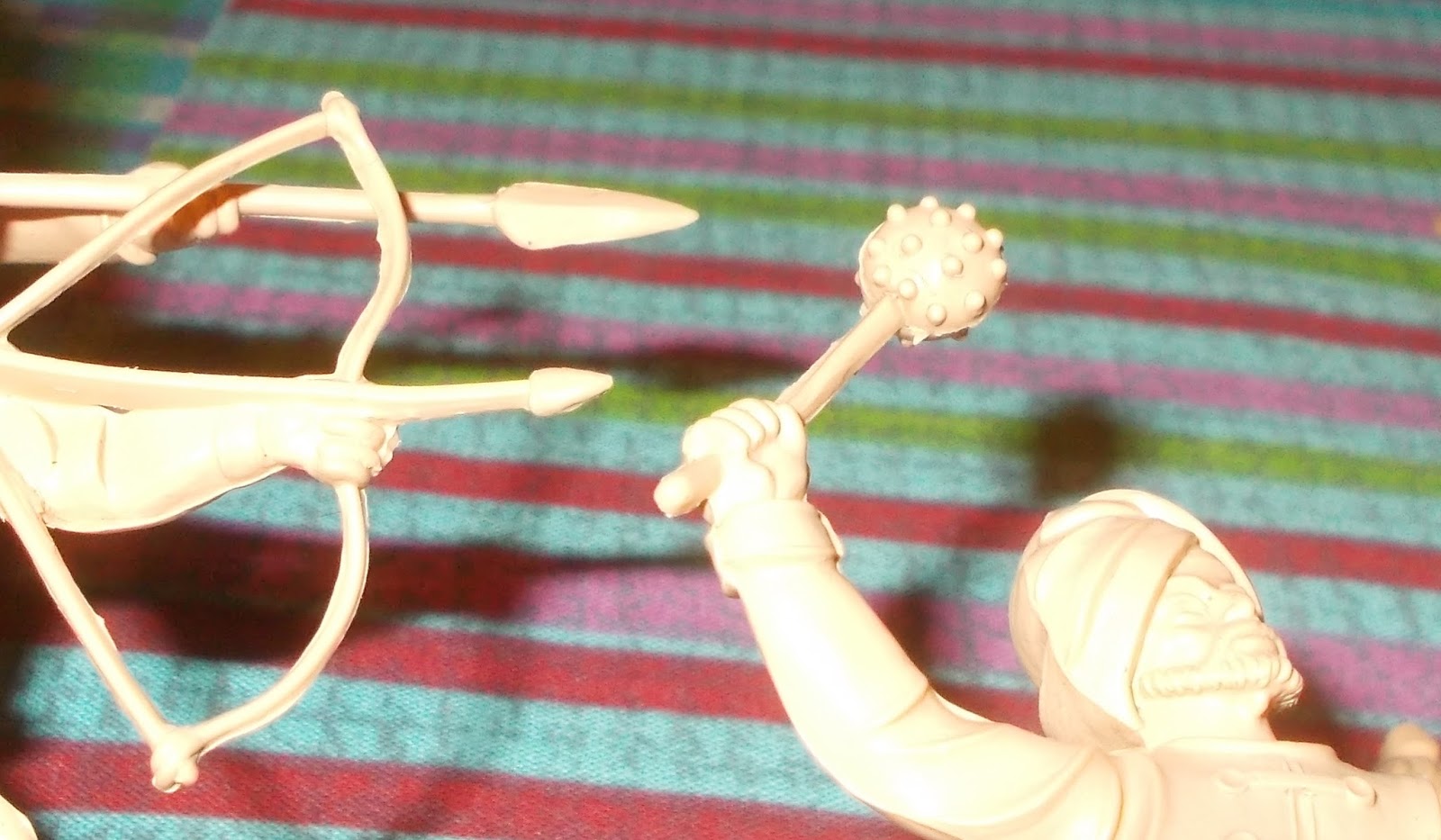
A set of Turkic warriors of the early Ottoman Empire era, similar to but not the same as those carried by Cané, copied from Elastolin, as Simonetti was working for Cané at the time, and Fontanini were letting them copy their Vikings while they (Cané) were borrowing their number-one sculptor, it's possible that the figures were designed by Simonetti for Elastolin, they are very different to other Elastolin stuff, and follow Simonetti's styling; and that he gave permission for Cané to reproduce them, as 'rack toys' in another (Italian) market.

Whatever the truth, it seems Fontanini didn't have a set of Turks otherwise? Now; when the grand children of Emanuele Fontanini set-up Fonplast in 1963, they would have needed to practice on something and practising with the composition figures still being made by Fontanini a few miles up the valley would have been daft, impractical and technically impossible. I think these figures, which are quite uncommon, indeed - were hardly known until a number of undecorated castings appeared recently - are those 'practice' pieces.

Described by some as ACW and others as Garibaldini, the presence of a lasso/lariat suggests these are meant to be US cavalry, to fight the set of Indians below. I'd like to say Custer's 7th, but what looks like a 7 in the image above is actually a star on the guidon.

It would appear that before (or as) they were tooling-up to produce for Fontanini, the Fonplast factory experimented with a cash-earner; a small range of 'Toy Soldiers', which are the figures seen here. I don't know how successful they were, but the fact that they seem so hard to find (excepting the recent find) would suggest they didn't take of - or even happen; commercially - see below.

There's a pose missing if they were all in sixes? Also apart from the above three sets, I am aware of no others, but the Turks would have needed an 'enemy'?

They don't have the more domed bases of Fontanini either, even the little 40mm 'Zulus' had the grass-etched dome of the rustics/nativity figures. These have a very commercial looking 'toy' figure's flat base.

But the older-looking packaging of both the African warriors and the pirates contain soft-plastic polyethylene figures, with the painted, vinyl figures apparently coming later (from the same moulds). If we assume the early experiments with other plastics (styrene and ethylene) were carried out up the road by Fontanini, that makes sense, with Fonplast not handling them (the moulds) until they were up and running with the PVC production, they were actually set-up to engage in.

The smaller-scale, factory-painted figures - Africans, the pirates, Cowboys & Indians and rural/pastoral types - were still being sold in the UK as cake-decorations from point-of-sale stock-boxes in the late 1980's, while the 'antiqued' white or cream polyethylene ones were much earlier.

Another clue as to the origin and fate of these figures is seen here; there is in this recent find - which I'm lead to understand was part of a bigger find in Italy - of otherwise near-mint, finely manufactured figures, clear signs of short-shot and heat problems with the moulding.

These are three of the Indians, but problems are also evident on the cavalry and I wasn't checking as I chose the figures from a larger sample, so I don't know how many of the figures in total had problems, but it seems to be about a quarter of the total?

Having worked with an plastic-moulding machine (lower pressure extrusions not high-pressure injection-moulds) my first thought was that it was problems with foreign-bodies on the injector-head, the blackening is usually a sign that something has got stuck to the inside of the nozzle, over-cooked and is contaminating the new resin as it flows over the contaminant . . .

. . . however, all the gate marks are at the tops of the figures, so that explanation doesn't fit.

The holes (on the left above is a similar blemish on one of the Turks) are simply where the plastic has got too cool to finish filling the cavity, something which is easier to understand when you realise the figure concerned was to be filled from the sword blade at the other end - I'm not sure which is the gate mark and which is a jigget, or if they are both gate-marks but I have highlighted them both anyway.

Of course trying to fill a large (65/75mm figure) cavity from a small opening at the opposite end was going to be problematical and while the blackening remains a mystery, the evidence is that all did not go well in the manufacture of these figures and with most of the obvious problems on the bases - as far away from the injector head as it was possible to get - I think these were an over-ambitious, sprue-gate too small, first try?

Finally; while this recent find is in a condition anyone who's seen them will tell you is 'near mint', there are signs that prior to being released to the market in the last year or so, they have been cleaned, and cleaned of a thick layer of dust, the sort of dust which has aged to a layer of fine, greasy, soil on the figures.

These figures appear to have been in storage, as an unpainted, slightly damaged, stock of 'seconds', for a long time - probably since they were made. As - to my knowledge (and I don't know everything!) - the 'firsts' haven't been seen either, I propose as a theory that they never got a full commercial release at the time, although some may have dripped into the world from out-painters, or via the children of Fontanini/Fonplast factory workers?

And that these 'seconds' are it; the 'firsts', the survivors of a trail run, failed experiments with a new technology, pulled-line, whatever - there's a story there still to be discovered. One thing I'm sure about, they are Fonplast and/or Fontanini, not some spurious company called Italy!

How many companies in the UK marked their figures 'England' or 'Made in England'; how many French companies marked 'France'; German companies 'Germany' or 'W. Germany' and err . . . Italian companies 'Italy'.

The idea that 'he who makes things up as he goes along' should think to invent another company; 'Italy-Dus'(it's his second this year - DGN post coming soon!) on such flimsy evidence as a base mark is extraordinary, that people are swallowing his guff is more so, especially when he's taking what he's publishing from other people's books - and happily admitting it as he regurgitates it, with errors, yet without proper credit!

PS - Don't forget it's the London Toy Soldier show tomorrow.

Tuesday, June 6, 2017

F is for Fontanini - Part 2 - Figures

It's funny - or Ironic - having started as a small-scale collector I have all the 35/40/50mm stuff, but in storage, so we'll look at all the commoner stuff (pirates, native warriors and nativity figures, along with cake decorations) probably as separate posts, years hence by which time there will be so much about them on the web they'll all, only be box-tickers, so may go straight on the A-Z listing?

While what I've picked up in the larger scales is bitty, and mostly Hong Kong copies, but it helps illustrate the variety of Fontanini's production which is the aim of this post.

I am less and less a fan of 'absolute' scale-gauge-ratio-size but I understand that some people do get excited by it, so throughout this article will give a double measurement thus; 65/75mm. The first number being the approximate distance between soles of feet and eye-line of an upright-posed figure (in millimetres), the second being the approximate total height of the item with integral base and/or added plinth, excluding plumes, feathers, crown-shards etc..

Tourists are funny animals, they don't like to be seen buying the cheapest option available, but few will go for the top-end either, as a result the main size of Carrara marble memento found is the mid-sized ones; five, seven, eight or ten-inch figures, which tend to turn-up in charity shops (thrift stores) regularly.

Here I shot two in the window of just such a shop - after closing time - only to purchase them a couple of weeks later when I noticed they'd been moved to a shelf at the back! They are probably not 'a pair', their bases are finished differently; one highlighted in gold the other left faux-ivory and the marble plinths are of different dimensions, but they have been brought together by someone recognising their common ancestry!

There are - as we saw the other day - much larger versions of these figures (up to nearly a meter) and smaller figures 70-100mm were also sold, these two are 150/190mm (6/7½ inches) and are finished in PVC washes from a subdued pastel palette, which gives a sun-faded, antique'y look to them.

These articles have been in preparation for a while and were going to be a quick overview about a year ago, but as items came-in the folder grew, and in recent months I have been actively seeking the stuff, and this chap came in last week!

He's another Carrara marble tourist's sample and the same 150/190mm as the previous pair, this is the commonest form of these to be found. The pose is one of four that go back to the 1960's, a second set of sculpts were issued as small scale 'toy soldiers' in the 1970's as boxed trays (one of each pose) and point-of-sale counter display boxes as individual 'pick-and-mix' figures.

Both sets bear the unmistakeable hallmarks of Elio Simonetti's work with the flowing garb, both hands occupied, facial expression bringing each figure to life and giving them not only character but 'personalities'. There were also pairs of earlier Georgian types.

Here we see Mr. Simonetti's work on the left with a set of Turkish figures from Fonplast's toy soldier range next to a set of US cavalry plainly designed by someone else, both are 65/75mm and in the same dense PVC of the bulk of Fontanini's products of the time, the raw material colour being the same as that used by the 45/50mm and 65/70mm nativity ranges of the time (1970-80's).

The Turkish set are also very similar to the Elastolin set copied/carried by Cané, it is likely Simonetti was behind both - I can't emphasise how important this sculptor was to the toy/model figure oeuvre, just as Stadden's (or Musgrave's) stuff turns up in every size, material and subject matter from sports trophies to HO footballers, so more and more stuff is becoming recognisable as Simonetti's work.

Compare the flowing bloused trousers of the Turks with the more rigid or padded look of the bloused cavalry trousers; the animation of the Turks against the more stilted, upright and uncomfortable-in-their-own-skin posing of the cavalry. Anatomically too, the cavalry are not quite as good as the Turks having rather too-long (yet somehow visually 'stumpy') legs for too short; almost childlike, torsos. While the kneeling firer has been to the Airfix school of pointless posing!

Although one can see in the Cavalry the influence of the master on the pupil, as the sculptor has learnt the both-hands-occupied rule and the sticky-out-stuff rule - Simonetti likes his sword-scabbards askew, coat tails flying, pointy hats, fishing rods, his are complicated figures to tool-up (as we will see in part 4), and the [trainee?] sculptor of the cavalry has clearly learned at Simonetti's side.

These (also 65/75mm) are harder to ascribe as they have little clothing and equipment, but their similarity to other Indians credited to Simonetti suggest these are the maestro's work, they're more naturalistic than the cavalry although it's fair to say the chap running with tomahawk and dagger is a bit of a dancing loon!

They also proved impossible to photograph so I've collaged the best of the flash images and the best of the heightened-contrast no-flash images. We will look at these again in a later post as I managed to purchase them a few months later and have shot them again.

A collection of copies, Fontanini were pirated to the n'th degree in the former British colony of Hong Kong, as well as closer to home, and these are a reasonable sample of those copies.

On the left we have a blow-moulded copy (68/85mm) of one of the Fontanini knights (75/95mm and probably not by Simonetti) usually sold as tourist trinkets at Italian historical sites, castles, museums, that sort of thing, and sometimes styrene in the original.

Next are the very common Chinoiserie premiums, these are copies (and came in several sizes) and while one tends to assume HK as the origin, the smaller ones (55/65mm and unmarked) were mostly issued in France or by French products, so there is a suspicion they may originate in France, although whether with permission is another matter and we'll look at them closer in a future post (part 5).

The larger one is clearly marked HONG KONG and comes in at 95/110mm but is missing his base which would adjust that second numeral, he has also been given a wash of 'antiquing' grey-brown.

The next figure is the most copied/licensed of all the output of Fontanini; the clowns (55/65mm). Again I have loads of the smaller ones in storage as their commonest form is as HK-sourced cake decorations, this one however is A) damaged (broken walking stick) and B) marked CHINA and not very old at all!


The last two are both those older Hong Kong copy cake decorations from the 1970/80's, a dancer (55/65mm) from the ballet set and a rococo/regency lady (45/50mm) of the same set as seen at the top of the page; a forth pose - a gentleman - is found, holding a candle/night-light.

The Men! We have compared the knights before, but putting a few together gives a better guide to the vast range available to anyone choosing to specialise in Fontanini (and their thieves), although were someone to seriously collect the Carrara marble sample figures that someone would need to reinforce the foundations of their property first as their plinths are not light, and there must have been hundreds produced in a dozen sizes and several decorative finishes over the years - a good set of the figures would result in tons of marble!

I'm seriously considering removing the marble samples as the figures come in and saving them up to make some sort of fancy door-step or something . . . but they've all got a hole in? Thinks . . . put round studs in the holes and voila! A heavy-metal 'cut-off', shoe-scrape, door-step . . . genius

The Ladies - with a close-up of the little HK cake decoration, I have  a lot more of these in storage; so we may well return to them one day.

It would appear that Hong Kong only copied the one pose in this size Certainly as a hard polystyrene plastic cake decoration you only ever seem to find the one (I have several more in storage), however they were also copied in soft ethylene at the larger size for French premiums . . .

(New rule -If you've stolen images from me
I'll have ten from you)

. . . as we can see here. Actually the girl second from the top of the staircase is also common as an HK copy, but smaller and often without a base, being attached to springs on jewellery boxes, or to a turntable on musical boxes as well as appearing as a 40/45mm cake decoration in gold or silver polyethylene.

Again believed to be the work of Simonetti, they are harder to ascribe as like the Indians above; they are a bit bereft of clothing, but the girl smelling the flowers is the give-away I think!

This is one of the sets where in the larger sizes there are variations in the sculpting, the fully overlapping crossed-hands of the Hong Kong cake decoration being absent from the 70mm premiums, but found with the larger Carrara marble figurines.

The variations in base style in the above image is due to them being cobbled together from more than one set by the same plagiarist who Photoshop'ed my Kellogg's divers into a cocked-hat!

I went to the Plastic Warrior show last month hoping to get a few Fontanini items to add to the growing folder these articles are the result of, and came away with 24 additions, of which this was one! Approximately 45/50mm and in a softer PVC, I think it's from the late 1980's or 1990's and has the new fountain mark we looked at yesterday. This seems to have been part of a reorganisation around 1983, as Simonetti started to take a more part-time/contract role in the firm he'd been with for 40+ years.

The nativity figures (from which this cow comes) were the bread & butter of Fontanini's output, and were issued in various sizes and vast numbers, with individual sculpts being retired and replaced with similar sculpts on a regular basis. There are a dozen or more Three Kings/Wise Men both mounted on camels and on foot, along with a kneeling trio, by the time you add the size variations, you could indulge in a cameo collection of just wise men!

Part 3 - Napoleonics next.

Monday, June 5, 2017

F is for Fontanini - Part 1 - Introduction

A surprisingly unsung company given that I would rate them with Britains, Elastolin, Marx or Airfix for their importance to the history of toy figures (in composition, plastic and resin); for the variety of their output, their connections to other companies with premium licenses, sculpt-swaps and shared output through the farming-out of their chief [and other] sculptor [/s] and through the wide range of their products blatantly pirated (as Garratt puts it) in Hong Kong in the 1960's and 1970's.

They pretty well got everywhere, tourist traps; breakfast cereals and coffee, washing-powders and cake decorations; high-end collectables and Hong Kong carded rack-toys, yet because they were never really a dedicated 'toy soldier' maker, you may have crossed their path without even knowing it.

Still-going; in the hills to the North of Florence and Pisa famous for the production of Presepi Artistici or nativity (Crèche, Krip[pen]) figures, they share the location with Marchi & Figli (Marchi and Sons) who (about the same time Fontanini were opening the Fonplast works) set up ISAS for their toy production, the four sites as good as filling the valley with figure production - both on the four main sites; and in all the little villages around the region where the (mostly female) out-workers completed the painting and finishing of orders.

Marchi came second (1930's) and are now (having re-absorbed ISAS and stopped the rack-toy production) known as Euromarchi while Fontanini set-up in 1908 and are now mostly making poured resin models for their main partner (and marketing guru's) in the US, Roman Inc; who have generated a whole fan-base of bible-belt and suburban 'soccer-mom' collectors with their own web-sites and forums, like Bradford Exchange, Danbury or Franklin Mint collectors!

Both companies are also now run by the forth generations of their families, and it was under the third generation of Fontanini's that Fonplast was set-up in 1963 to manufacture plastic figures in volume as the older ranges were phased-out.

Now: to the English-speaker it's probably easier to say that those older ranges were composition; however, some sources (including the current Fontanini) translate some of the early production as being papier mâché, others as 'plaster' or plaster-covered papier mâché, while in 1951/2 they were registering groups of figurine designs (from 6 to 13 inches high) with the US Library of Congress as 'ceramic', so the picture is not entirely clear.

Certainly though; we know they made composition figurines of the Elastolin/Lineol type between the wars and through to the 1960's until the switch to plastic.

Away from the Nativity ranges and limited dips in the toy market, Fontanini are best known (or instantly recognised - once you know what you're looking at) for their larger mouldings, supplied in various finishes to the tourist trade in Carrara and the surrounding regions, where they are affixed to a block or tile of 'sample' marble, for sale as mementos of a trip to the region, Fontanini's own plastic-based statuettes being sold more widely around/elsewhere in Italy in the same vein.

It is sure that Elio Simonetti (who joined the company after the second World War, and not Emilo!) and the other sculptors at Fontanini worked with the tourist trade to produce figurines they thought would sell, and that they also worked with the Val Pelro (valley of lead, or 'lead valley') metal foundry where much cross-over or cross-pollination existed, while his work with Cané ('canine' or dog) between 1971 and 1975 was almost certainly with the blessing of the Fontanini's and probably to the financial gain of Fontanini/Fonplast.

As can be seen on the map these firms were all relatively near each other, and Ferrero who would produce small-scale, die-cast copies of many of the Fontanini, Cane and/or and Peltro sculpts (along with the much pirated Lone Star 'Metallion' sculpts - also Simonetti's work) in their chocolate Kinder Eggs, set-up in the 1970's in the same Northern-Italian 'neighbourhood'.

The fact that the Cowboys and Indians of all the above named resemble the Marx sets is probably because Simonetti designed them too, and I wouldn't mind betting (this was all happening in the late 1960's/early 1970's) that he got the gig through Roman in the US who were on the scene by then, but A) I'm getting ahead of myself, and B) it's my own thoughts - so treat it with a pinch of salt.

Markings are many and varied with Fontanini and can lead to confusion, some of the older members of the hobby will tell apocryphal stories of people coming up to them at shows and announcing that they've "...found a new company; Depose!", while the logo is itself problematical, or at least: it was; it's now been replaced with a graphic of a fountain.

On the left we see an image of a typical base mark on one of the larger statuettes with the Depose Italy (registered [in] Italy) a mould-tool/stock number and the logo, along with the standard Carrara marble's self-adhesive, chrome-metallised, paper (later: vinyl-plastic) label.

On the right - a close up of 'That Mark'. Now - the company themselves tell a tale of papier mâché toy spiders, most people - now - refer to it as a spider -despite the lack of legs being present in the correct number, Garratt thought it was representing a crab, for which job it is lacking the prerequisite claws while I think it looks more like a sheep-keg or blood-sucking, burrowing tick before it's fed (although they have eight legs too!), and on some toys it (the logo) looks to have only four legs and two antennae!

I suspect it was originally meant to be a beetle; clockwork, hand-powered or spring-loaded automata of walking beetles (usually painted-up as ladybirds/ladybugs) were common, popular playthings between the wars in wood, tin-plate or composition and if they were making spiders, they were probably making more beetles, spiders being less popular?

Whatever the truth, it is considered to be a spider now, was present (usually on the base underside) from the early composition figures through to the mid-1980's or even early-1990's and has now been replaced, yet without a full explanation as to why - why would you replace a logo which was over 70 years old and instantly recognisable?

On the left - a late vinyl cow from the 1980's onwards (it could be quite recent, I don't follow the Roman Inc. era stuff closely) with a cloudy blob for the fountain, a full 'Fontanini', a copyright ©-mark and 'Italy'.

On the right - the plain 'Italy' mark of the Fonplast figures from a short lived attempt at a slice of the 'Toy Soldier' market. Someone (guess who!) has been trying to pass these off as being from a company called err . . . Italy, quite vociferously, in recent months, in various grubby corners of the internet, but he tends to make stuff up as he goes along and is best ignored in his pontificating.

Other marks (along with any cavity/stock numbers and/or 'spider') can include any combination of the above and/or including:

  • 'Dep. ITALY'
  • 'DEPOSE'
  • 'Depose Italy'
  • 'Depositato Italy'
  • 'Fontanini'
  • 'ITALY'
  • 'MADE IN ITALY'

Variations in base/plinth attachment with an all-hard polystyrene plastic combination on the left and a vinyl (PCV) figure to polyethylene plinth pairing on the right.

There was a limited use of both styrene and ethylene from time to time or with certain sets (possibly from the old Fontanini facility up the road at Bagni de Lucca?), but most of the 'classic' Fontanini/Fonplast production circa 1965-1985 was in a very dense PVC which takes a lot of punishment some (softer batches) coming across as ethylene on casual inspection, some cured so hard it can be mistaken for styrene - this would have been from the Chifenti Fonplast works - down the road!

The flexibility and 'give' of PVC also takes an old-fashioned, slotted wood-screw far better than either polystyrene or polyethylene would have, which made the fixing of a plastic figure to a chunk of the planet's harder surface material a lot less problematical!

Spirit-based glue was also applied to the join between the figure's integral-base and the additional plinth; to prevent the figure coming loose easily under the scrutiny of small, inquisitive, juvenile fingers back in the tourist's home location.


"Ah-Harrrh Jim-ladd ! Oi's bee wiseerrh noww! . . .
. . . Oi's bee Farnt'aaan'innii!"

Next - we'll look at the figure types using my rather small sample - no internet images here and I'm not copying it all out of someone-else's book!