
About Me

My photo
No Fixed Abode, Home Counties, United Kingdom
I’m a 60-year-old Aspergic gardening CAD-Monkey. Sardonic, cynical and with the political leanings of a social reformer, I’m also a toy and model figure collector, particularly interested in the history of plastics and plastic toys. Other interests are history, current affairs, modern art, and architecture, gardening and natural history. I love plain chocolate, fireworks and trees, but I don’t hug them, I do hug kittens. I hate ignorance, when it can be avoided, so I hate the 'educational' establishment and pity the millions they’ve failed with teaching-to-test and rote 'learning' and I hate the short-sighted stupidity of the entire ruling/industrial elite, with their planet destroying fascism and added “buy-one-get-one-free”. Likewise, I also have no time for fools and little time for the false crap we're all supposed to pretend we haven't noticed, or the games we're supposed to play. I will 'bite the hand that feeds', to remind it why it feeds.

Monday, April 10, 2017

News, Views Etc . . . Sandown Park Spring Show

So, went to the first Sandown of the year a few weeks ago, these are a few shots I took of the meet for those who don't know just how big it is. The photographs have ended up in a rather reverse order so we start . . .

. . . in the annex looking back down toward the main halls, the annex is mostly full of HO train dealers and a couple of modern truck sellers, but Abid has his stall here (see below) and there is a toy soldier stall hidden among the heads at the top of the picture on the right!

Hall three from the raised area back across to the race-day restaurants. This is about half the stalls in the hall with Mercator Trading and a couple of other toy soldier dealers out of shot to the left of the picture. There are also stalls on the raised section and off to the left by the main race-side entrance.

This is looking diagonally across hall 2 toward the winners circle windows (the opposite angle/direction to the previous shot but 100 yards further down, there aren't many soldier dealers in this section, but a lot of the mixed vintage toy dealers stall-out here so this is where you find odd space tanks and Palitoy 'planes . . . well - I do!

Bottom left corner of hall 1 looking toward the eateries, Plastic Toy Soldiers (PTS52 on eBay) is hidden in his own alcove just out of shot to the right, but everyone going for food or drink has to pass him so it's quite a prime spot!

The other side of hall 1, I think Steve Vickers is down there in the far corner somewhere and there are a couple of other toy soldier dealers in this hall, but while there aren't the number of toy soldier dealers you would find at a 'Toy Soldier' show, it's a fact that a lot of the tables will have a tub or tray of figures or the odd bargain as other 'toy people' realise their worth, or understand that they are worth 'something', and it's often where you find the interesting things that might otherwise not have come to light, such as yesterday's pair of ceremonials.

Even the connecting arms between the halls are stuffed with stands and this one linking Halls 1 and 2 past the service-core between them is no exception, Help Empty My Attic being a name probably familiar to those of you who spend much time on evilBay.
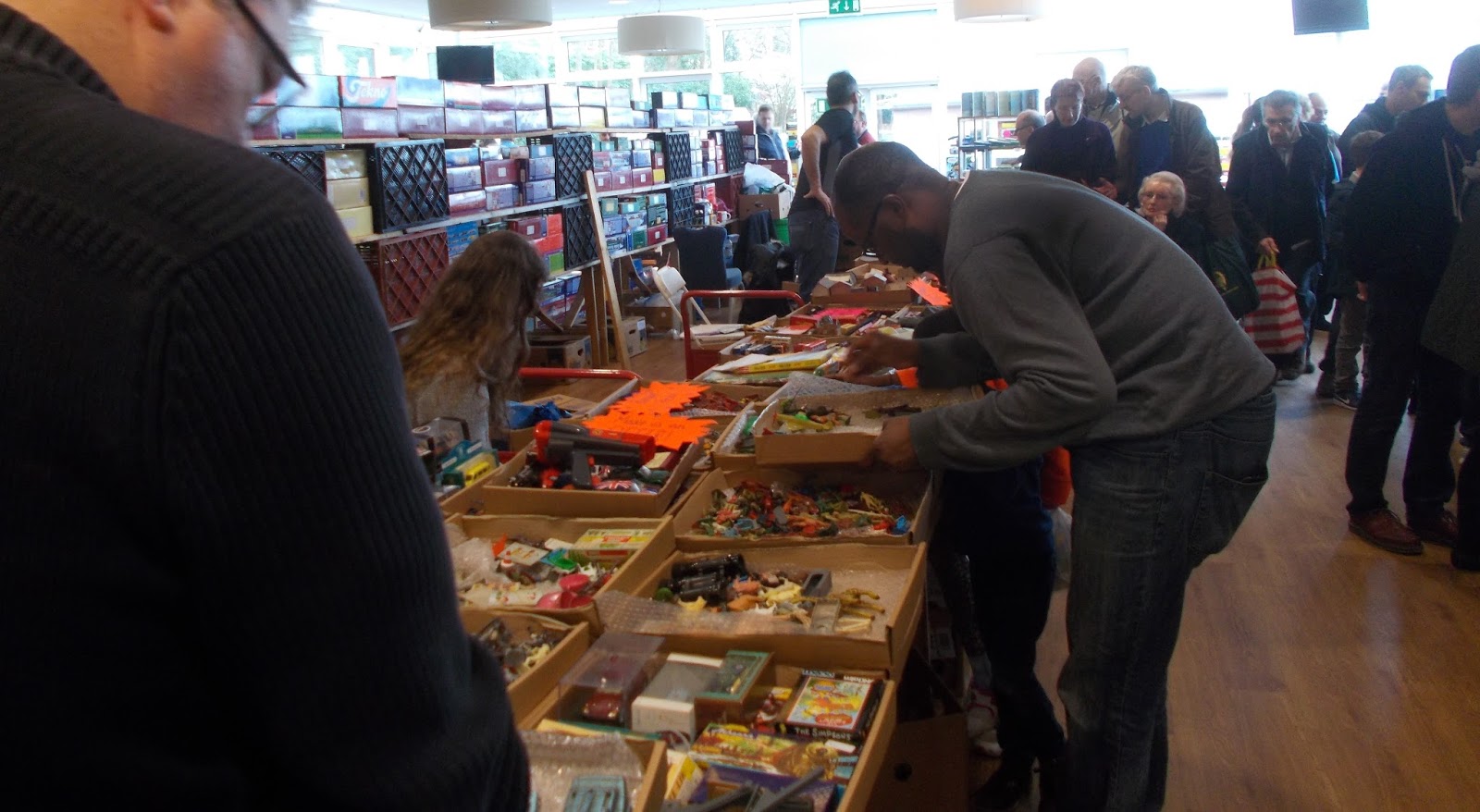
It was at Sandown that I realised my camera was getting long in the tooth, and as well as noticing the gribbles on the lens, it's not so hot on wide shots anymore. This is Abid's stall back up in the annex and Abid has literally - a little bit of everything! There's always a bargain to be had, and while he was free to be photographed while I was chatting to him; as soon as I got the camera out he got customers!

Abid is always looking for new stock so if you're looking to sell a collection, part collection or just thin-out a collection - try giving him a buzz.

Sunday, April 9, 2017

C is for Curate's Eggs

Bit of an odd assortment today, but interesting nevertheless! I have picked these up in ones and twos over the last few years and the only thing linking them together is that they are all apparently taken from old poured-lead hollow-casting or solid moulds.

I picked these up the other day and they may or may not be 'new' to the hobby, I say "...may not..." as they might already be in the Plastic Warrior [link] magazine 'Special' edition on hollow-cast to plastic mouldings which was issued a few years ago now. My copy is in storage and I intended to pick another up from the Editor the other day but plans changed so I'm still in the dark as to their position in 'the cannon'.

On the left in both shots is what seems to be a new (third plastic) version of the Charbens Household Cavalryman (here given a Horse Guards treatment - No. 291 in metal) while the right-hand figure is a Crescent US style infantryman with bugle, although in Joplin's 'Great Book' (see; Mr 'Emsworth Library' chap, now you know why I needed it!)* they are just described as Khaki Infantry with this one coded FC92 by Crescent in metal, and here given a rather wacky paint-job!

The metal originals in The Great Book of Hollow-cast Figures by Norman Joplin (photographed in low-resolution and at deliberately distorting angles for obvious reasons), this shows the pre-war version of the bugler, post war he was re-issued with a green helmet or paler fatigues.

The Household Cavalryman would get two further versions in plastic, a similar copy of this one but with a larger thinner base, and then a more obviously re-cut one on a heavy ovoid base, both however taking the pose as here with the awkward holding of the sword out to the side with a straight arm - try it! You did, didn't you? You just made a right-hand turn signal, don't worry, so did I and I've done it before!

The Charbens collection is so small it has its own box - which is in storage - so they were missed out when we looked at the other Household Cavalry, what; six or seven years ago? So we will look at them again - all three versions together - another day, but I have picked-up a few more mounted figures (in the storage-lot there are black, white and brown plastic with various saddle-cloths including orange) as a size'er.

This chap (black one) came in with a bag of odds and sods from a charity shop about six weeks ago, and would appear to be the Cherilea (all the British 'C's today!) hollow-cast moulding (No. 6/11), of interest as in plastic they produced the two over-scale examples in the lower shot - the new one can 'play' being a bantam!

Again I say 'would appear' as in Joplin's book a black hen is photographed against a black background and seems to have a slightly thinner neck and different tail, but the only other close one is a Barratt's hen which is more of a U-shape without the flat back. Or/also the neck may have needed thickening to inject plastic effectively?

The real curate's egg of this bunch; I assume he's Charbens, he matches the style of their other farm animals, and in particular; the [other] rearing foal, upon-which this one seems to have been based, but with the back in the air. I can't find the pose in any of the hollow-cast books or plastic resources and Dave Scrivener didn't know of it?

I have one in what looks to be good factory paint and one tatty, chewed one which may have been painted, maybe not, there's no residue anywhere? The back legs look similar to the Charbens wagon horse but the front legs seem to have been carved out of the mould tool by a 16-year old on day one of a Youth Training Course!
 
I would be interested in anything else on this sculpt.

-------------------------------------------------

With regard to Plastic-from-hollow-cast generally I was musing with Paul Morehead a while back on the possibility that while we know some moulds ended-up elsewhere, might some of them have been issued by the parent companies of the lead figures, perhaps as an initial toe-in-the-water testing of the likely plastics market?

It would make sense to purchase a small single-shot hand press (for a few hundred pounds?) and run a few figures off, distributing to maybe a dozen or so local corner shops and newsagents (of which there were a plethora in the 1950's) in the streets near the factory, on sale-or-return or gifted (for feedback), before investing the vast amounts needed to obtain an automated machine . . . or two!

*It'll be back with you in May, we've just been given a four week extension on all books as the renovation has over-run - sorry!

Saturday, April 8, 2017

G is for Guns, Proper Guns!

The first is from Basing House and - I'm pleased to report - is pointing directly at the centre of Basingrad! Sadly it's probably out of range for the era, but one lives in hope! The police station, magistrate's courts, council offices and job centre are pretty much in a straight line away in the distance . . . with 'Macky-D's' between!


This one (below) is in a park in Maidenhead and probably has a history but I don't recall it now?


Seems to have been lost in the ground or water for some time; the outer surface is much pitted. Still - a nice little thing!

Friday, April 7, 2017

R is for Royalist Redoubt!

The 'citadel' gatehouse, one of the three or four main keeps in the Basing House complex and a lovely model, around 1:72nd scale, but again - only an interpretation due to the destruction at the time and lack of contemporary images. Also a 'Lobster's' cuirass in the background!


That's it, three pictures; fighting flash and reflection! Model made by Boyd Hill in 2009.

Thursday, April 6, 2017

O is for Old Basing

The village/hamlet to which the ruins of Basing House are now abutted.

This plaster model is closer to 15mm (for the gamers among you) and has given very different treatments to the layouts of both complexes, also you can see clearly how the landscape contours would have affected fighting in a way you can't really replicate on a gaming table


You can also see how fortified they were in this simplified architectural model, I count six keeps, a few other blockhouses and a more than a dozen other towers and turrets, both are walled and both [dry] moated along with other walls, banks and ditches. Note also the four bridges and central courtyard between both complexes and the main gatehouse/keep.

It was a formidable objective, raised above the surrounding landscape and with stores for a siege - its eventual taking must have had a negative effect on the Royalist moral and wider war-effort.


The two blurb panels are interesting reading from the period.

Wednesday, April 5, 2017

G is also for Garden


The least accurate model and the last of the Lego-like'ies, but first a look at the actual walled garden, one of the few restored bits with two dove coops of substantial size which must have kept the garrison in eggs and meat for a portion of the siege, had they also started using pigeons for messages by then, I think they must have?


The model for some reason just shortens the wall to exclude the area now used for picnics on nice days. Despite being a ruin, this is a decent day out and the village of Old Basing has some fine hostelries - while the car park for visiting the old house is also the pub car park for a Wadworth's Inn while coffee, ice cream and snacks are available from the Little Barn vistor's centre

I collaged the above three to make it easier to compare the real with the model. The big tower (a granary?) in the model is long-gone while the space occupied by the square tower at the near-end of the wall is now squatted by a glorified potting-shed which doubles as a small museum of artifacts from the site and some other models, including the Lego garden. A few of those artifacts (mostly tiles - another interest of mine) are shown below, but again; better visited, than vicariously peered at on the Blog!


The signs of burning are from the sacking of the two fortified houses after they fell, the remains of the whole complex are a grassy hill, apart from the garden - off to one side and relatively out of harms way, i dare say it was a bit of a state for a century or two before restoration!

Tuesday, April 4, 2017

G is for Great Barn


There was some significance to the existence of the Great Barn which totally escaped me, if you are a student of the ECW you may be able to enlighten the rest of us! It was a better model, if only because it was modelling a common building of the type, in a larger scale than the house models!


Although, it's not looking loved, bits missing, bits tipped over, bits hanging and the whole covered in a thick layer of dust!

Monday, April 3, 2017

N is for 'New House' at Basing

The Tudor 'New House' complex looks pretty (shades of Hampton Court Palace) but is basically a series of heavy keeps, joined together by corridors of ancillary buildings (stables, cookhouses, workshops, servants quarters &etc.) and enclosed by a fortifying wall.


Again the modelling material has its limitations and the buildings are a bit too 'gridded', but it would make an excellent war-game - with all those redcoats and bluecoats Lego used to issue with their pirates!

Sunday, April 2, 2017

O is for 'Old House' at Basing

In the visitor centre and the entry hut at Basing House there are several Leading Brand Construction Toy models of the various buildings central to the story of the siege of Basing House in the English Civil War, colours of the bricks would suggest that a lot of the construction was carried-out with cheaper 'not so leading brand' bricks!


Behind the display is a photographic display of the building of the models, but it's not easy to digest due to the museum-style rope-barrier and model tables in front of it!

Because of the difficulty of modeling with a fixed dimension format like Kiddybrix-call-me-Lego not everything is properly fixed down and the rather charming fountain/well was looking particularly drunk; equally, not everything is that accurate to the real-life buildings, but with the buildings lost at the end of the siege and little recorded of them prior to destruction - it's open to the interpretation of the artists of the various models, and what is known of the foundations and found-materials.

Saturday, April 1, 2017

B is for Basingrad Bronze

These have been in Picasa since the autumn of 2014, so it's about time they got an airing, although they will probably be of more interest to the War Gamers or general historians than the toy collectors, but I try to entertain all sorts here!

This is one of several models of Basing House (or 'Basing Castle') we will be looking at over the next few days and is the all-weather outdoor site-model of the whole siege-area, cast in bronze and positioned so that you can place the remains in the context of the time - we won't look at the remains, they really aren't anything to look at and I didn't photograph them!

I believe the walls were part of a more permanent or existing defence, but most of the banks and ditches (not the main dry-moats to the house complex but those further out) are from the ECW siege.

Another view of the main house complex which was actually two houses, the old circular-walled 'Norman' fortified house and the more modern 'New House' where the family lived in rather grander splendor that the old buildings could provide, the two entered through a citadel gatehouse to the North - removed by vandals.

At this scale the New House looks to be a nice Elizabethan country house, maybe half timbered and a bit posh, and it was all those, but it was also as heavily fortified as the old house and made for war not Waugh; If you get what I mean!

The whole site - mid-siege; the Parliamentary forces surrounding the house on the river plains, while the Royalists sit on the hill slowly getting hungry!

I think this would benefit from a midnight commando raid (it's not terribly secure) with a handful of micro-tanks so that the next day tourists find a motorised panzer regiment streaming in from the top, while tank destroyers sit waiting in the village with an A/T-gun screen and a mixed battle group is strung-out over the old main camp of Parliament to hold the wing and direct the armour along the river toward the anti-tank ambush!

One day I'll drink enough to get caught doing it - torch in my teeth; "Peow-peow"!